
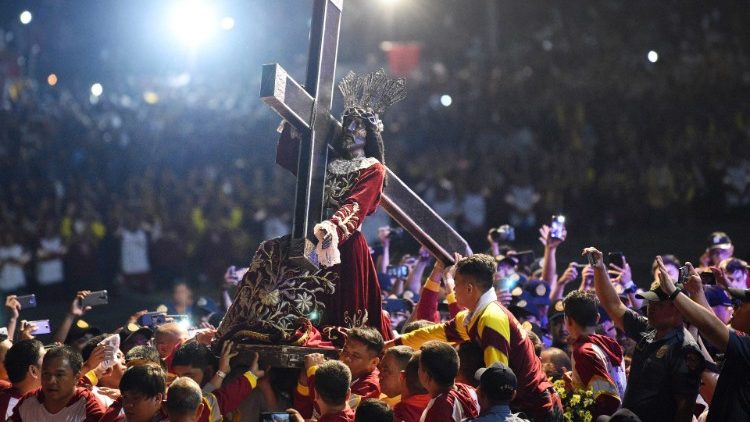
Faith, Survival, and Silence: A Theological Reflection of the Feast of the Black Nazarene
The Feast of the Black Nazarene remains one of the most powerful and contested religious phenomena in the Philippines. Every January 9, millions participate in the Traslación surrounding the image enshrined at the Black Nazarene. Theologically, the devotion is often praised as an embodiment of solidarity with the suffering Christ. Yet on the ground, its meaning is far more ambivalent. What is revealed is not only deep faith, but also desperation, resignation, and a troubling pastoral silence (CBCP, 2013; Vatican II, 1965).
This article does not dismiss the devotion. It interrogates it.
Faith or Religious Survival?
What often manifests in the Traslación is not always mature Christian faith but what may be called “survival religiosity.” This form of devotion emerges when people cling to God not out of reflective discipleship, but because every other institution has failed them (Gutiérrez, 1973).
It is marked by:
- transactional logic (“If I touch, I will be healed”)
- magical expectations (power transferred by physical contact)
- desperation theology (“Only God can help me now”)
- lack of agency beyond ritual participation
This is not outright superstition in the strict theological sense, but pre-evangelical faith—faith still shaped by fear, scarcity, and powerlessness. The Church has historically tolerated this as incipient belief. The problem arises when it is never allowed to mature (Paul VI, 1975).
God as the “Last Resort,” Not the Liberator
For many devotees, God is encountered not as:
- the One who calls for justice,
- the One who confronts oppressive systems,
- the One who sends believers to transform society,
but as the final option when everything else has failed.
In this distorted framework:
- God becomes an escape valve, not a transforming presence
- prayer replaces protest
- endurance replaces resistance
- suffering is spiritualized instead of challenged
This is not the biblical God of Exodus or the prophetic Christ of the Gospels. It is resignation clothed in devotion (Cone, 1970; Sobrino, 1994).
The Uncomfortable Role of Church Leadership
The popular narrative often celebrates how Church leaders “support” the Traslación. Yet support is frequently limited to ritual endorsement.
In practice:
- clergy bless the procession but rarely organize sustained anti-poverty action
- the institutional Church benefits from massive devotional participation
- prophetic confrontation with political and economic power is selective, symbolic, or avoided
The result is a dangerous imbalance:
The poor are encouraged to suffer piously, while the structures that cause their suffering remain untouched.
This is precisely the condition critiqued by Liberation Theology: religion functioning as consolation without transformation (Gutiérrez, 1973; CELAM, 1979).
When Popular Piety Becomes Complicit
This must be stated without euphemism. Popular devotion can unintentionally stabilize injustice when:
- suffering is glorified rather than challenged
- poverty is interpreted as a “cross to carry”
- hope is postponed to miracles instead of organized change
- Christ’s Passion is emphasized without His confrontation with power
When these dynamics prevail, devotion becomes theologically incomplete and socially dangerous (Francis, 2013; Vatican II, 1965).
This Is Not the Fault of the Poor
The devotees are neither naïve nor ignorant. Their faith is a rational response to lived realities:
- institutions that have failed
- justice systems that are inaccessible
- political promises that ring hollow
- social mobility that is structurally blocked
In such conditions, clinging to God is not superstition. It is survival (Scott, 1985).
The deeper failure lies elsewhere:
- catechesis that stops at ritual
- leadership that avoids conflict
- a Church that comforts without empowering
An Ambiguous Feast
The Feast of the Black Nazarene is not simply holy nor simply flawed. It is theologically ambiguous.
It is:
- a cry of faith and
- a symptom of systemic abandonment
It reveals both:
- the depth of Filipino spirituality
- the depth of Filipino social brokenness
To praise the devotion without addressing injustice is pastoral negligence.
To condemn the devotion without addressing injustice is theological arrogance (Paul VI, 1975; Francis, 2013).
What an Authentic Christian Response Would Demand
If this devotion were fully integrated into Gospel faith, it would compel Church leadership to:
- preach Christ not only as suffering servant but as judge of unjust systems
- accompany the poor beyond the procession
- translate panata into sustained social action
- transform devotion into formation, not spectacle
Without this conversion, the Traslación risks becoming what critics have long warned against—not because faith is false, but because faith is allowed to anesthetize pain rather than confront its causes (Gutiérrez, 1973; Sobrino, 1994).
Conclusion
The central question is no longer whether the devotion is sincere. It is.
The unresolved theological question is far more unsettling:
Does the Church allow the poor to carry the cross forever, or does it ever help take it down?
Until that question is answered in practice—not only in sermons or processions—the Feast of the Black Nazarene will remain a powerful symbol of faith, and an equally powerful indictment of institutional silence.
References
CBCP. (2013). Pastoral exhortation on Filipino spirituality and social responsibility. Catholic Bishops’ Conference of the Philippines.
CELAM. (1979). Puebla: Evangelization at present and in the future of Latin America. CELAM.
Cone, J. H. (1970). A black theology of liberation. Orbis Books.
Francis. (2013). Evangelii gaudium [Apostolic exhortation]. Vatican Press.
Gutiérrez, G. (1973). A theology of liberation: History, politics, and salvation. Orbis Books.
Paul VI. (1975). Evangelii nuntiandi [Apostolic exhortation]. Vatican Press.
Scott, J. C. (1985). Weapons of the weak: Everyday forms of peasant resistance. Yale University Press.
Sobrino, J. (1994). Jesus the liberator: A historical-theological view. Orbis Books.Vatican II. (1965). Gaudium et spes [Pastoral constitution on the Church in the modern world]. Vatican Press.